
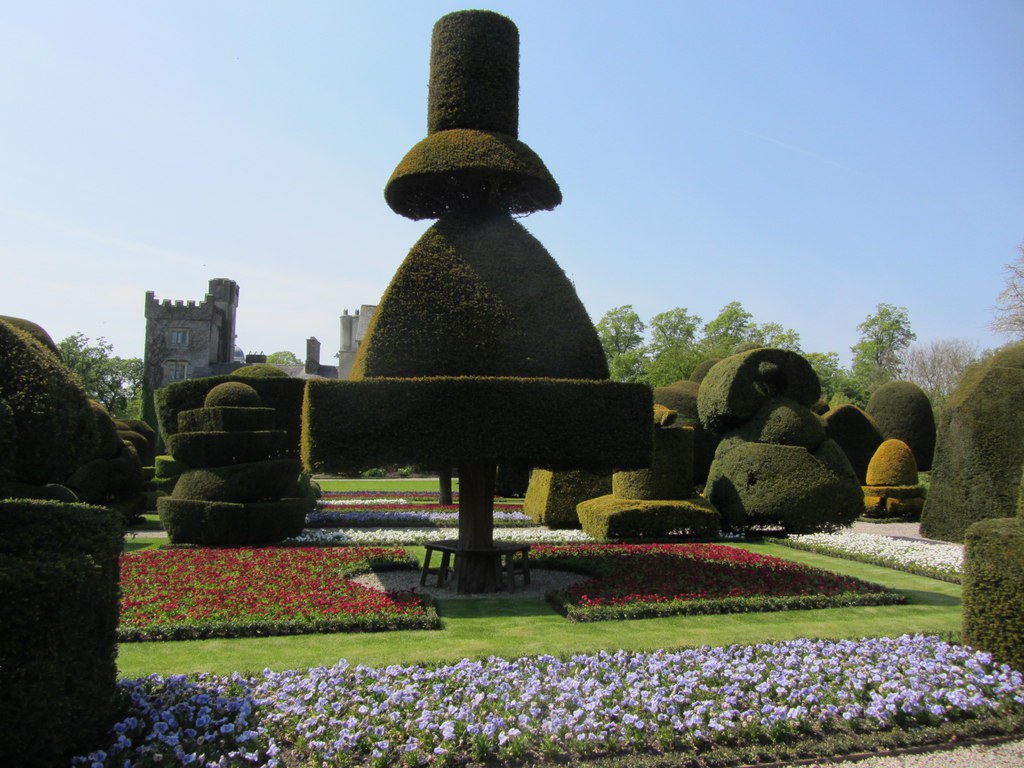
Topiary in the Kent Valley
Levens
A southern Lake District village where hand-clipped yews, an Elizabethan hall, riverside paths and limestone heights make a richly varied day.
- Best for
- Historic gardens, café food and valley walks
- Give it
- A measured half-day, or longer with Scout Scar
- Don't miss
- The garden's centuries-old shapes, still cut with hand shears
Photo: Colin Park · CC BY-SA 2.0 · cropped
The Fox verdict
Come for the topiary; stay for the valley
Levens turns one remarkable historic garden into the centre of a flexible visit, with a hall, riverside walking, a proper village inn and Scout Scar farther north.
The topiary is the singular draw: more than a hundred clipped forms survive in a garden laid out in 1694. The Elizabethan rooms add depth, while the River Kent and Scout Scar open the day into the surrounding landscape. Food is covered at both Levens Hall and the Hare & Hounds, so the visit can be paced without rushing.
Where to go
Places in Levens
Every place below is checked against a published source, listed with what it is and how long to give it.
Local signatures
3 placesLevens Hall
A medieval pele tower enlarged into an Elizabethan mansion, with original panelling, plasterwork and carved chimney pieces inside.
- Visit length
- Editorial estimate: allow around 90 minutes
- Locality
- Levens Hall estate
- Access
- Seasonal visitor opening—check the Official site before travel.
Levens Kitchen
Levens Hall’s café for food and drinks during a visit to the estate.
- Visit length
- Editorial estimate: allow around 60 minutes
- Locality
- Levens Hall estate
- Access
- Check the Official site for current opening before travel.
Scout Scar
A limestone ridge above the Lyth Valley, with views towards the Lakeland fells and Morecambe Bay. The map pin marks the official route’s car park start.
- Visit length
- Editorial estimate: allow around 90 minutes
- Locality
- Scout Scar route start, north of Levens
- Access
- The Lake District National Park Authority route starts at the Scout Scar car park (grid reference SD 488924); check the official route before travel.
Food & drink
1 placeHare & Hounds Inn
A 16th-century coaching inn serving comfort food, cask ales and craft ales, with a welcome for children, muddy boots and dogs.
- Visit length
- Editorial estimate: allow around 90 minutes
- Locality
- Levens village
Walks & outdoors
2 places
Levens Hall Topiary Garden
More than a hundred old yews form geometric shapes, abstract figures, chess pieces and crowns in a garden laid out in 1694.
- Visit length
- Editorial estimate: allow around 90 minutes
- Locality
- Levens Hall estate
- Access
- Seasonal visitor opening—check the Official site before travel.
River Kent Walk
A River Kent outing using riverside paths through the grounds and continuing south towards Heversham.
- Visit length
- Editorial estimate: allow around 2 hours
- Locality
- Levens Hall grounds towards Heversham
- Access
- The route uses paths through the Hall grounds; check the Official route and Hall visitor information before travel.
No places match this filter. Choose All places to reset the list.
Three ways to explore Levens
Signature outings
Enter the topiary's strange green world
Move between more than a hundred clipped yews, from geometric forms and abstract figures to chess pieces and crowns.
Order comfort food at the coaching inn
Pair a pizza, burger, fish and chips or pot pie with one of the Hare & Hounds' cask or Cumbrian craft ales.
Find the long view from Scout Scar
From the official Scout Scar car park route start, take to the limestone ridge for views towards the Lakeland fells and Morecambe Bay.
The village story
Levens: Shears, Stone and the Kent Valley
The unchanged Travel Fox article follows the village from its surreal topiary and valley setting through food, walks, the Hall's layered history and the practical journey in.
A Garden Unlike Any Other
In the garden at Levens Hall there are more than a hundred pieces of clipped yew, some of them over three hundred years old, arranged as geometric shapes, abstract figures, chess pieces and crowns. They are cut by hand shears every August and September. The Guinness World Records recognises it as the oldest topiary garden in the world, and standing among it the effect is fairly surreal — a village on the southern edge of the Lake District that happens to keep a three-century-old set of green chess pieces in trim.
The village sits in the Kent Valley, about five miles south of Kendal and ten from Windermere, with the Lyth Valley running north and the limestone edge of Scout Scar to the north. The River Kent runs through the grounds of the Hall itself.
The Village Table
The pub is the Hare & Hounds Inn, a 16th-century coaching inn run by Ash and Becky Dewar since 2013. The menu is long — pizzas hand-rolled to order, eight kinds of burger, fish and chips, pot pies, grilled dishes. There are five cask ales plus craft ales from local Cumbrian breweries, and it is CAMRA-listed. One review sums up the door policy: "Everyone welcome — kids, muddy boots and dogs." Given the walking around here, the muddy boots are not a hypothetical.
For food and drinks there is Levens Kitchen at Levens Hall; check its current opening before travel.
River Paths and Old Stone
The riverside walking starts around Levens Hall, about 0.8 miles from Levens village centre in a straight line. The River Kent gives you riverside paths through the grounds and south toward Heversham. About 4.0 miles north of Levens in a straight line to the official route start is Scout Scar, a limestone ridge above the Lyth Valley with views to the Lakeland fells and out to Morecambe Bay. The valley floor below is damson country — the orchards are what the Lyth Valley is known for, and there's a Damson Day held every April at Crosthwaite.
The Hall began as a pele tower, built around 1350 by the Redman family as a defence against Scottish raids. James Bellingham extended it around 1580 into the Elizabethan mansion that stands now, with its original panelling, plasterwork and carved chimney pieces still inside.
Beaumont's Garden and Bank-Holiday Steam
The garden came later, and by a strange route. In 1688 Colonel James Grahme — Keeper of the Privy Purse to James II — bought Levens and brought in Guillaume Beaumont to lay it out in 1694. Beaumont had been gardener to James II and had a hand in the gardens at Hampton Court, and was reputedly a pupil of the man who designed Versailles. Topiary went out of fashion in the following century, and grand houses across England tore theirs up for landscaped parkland. Levens simply never did.
On bank holidays the grounds also show a collection of working steam models, including a steam-powered fairground.
Roads, Rails and the Annual Cut
Getting here is straightforward: the A590 and A6 south of Kendal, with M6 Junction 36 about four miles east. The nearest stations are Oxenholme on the West Coast Main Line, roughly four miles away, or Arnside on the Cumbrian Coast Line to the west.
The hedges get their annual haircut at the end of every summer, one pair of shears at a time.
Stay around Lake District
Make a longer stay of it
Travel Fox holiday homes around Lake District, linked directly to their property pages.
For homeowners
Own a holiday home near Levens?
We manage holiday lets across the Lake District from 12% commission, charged after cleaning costs, with no lock-in. A co-founder visits before you decide.
Holiday let management in the Lake District →
A guide with a point of view
Written from research. Edited for real journeys.
Use the Official site links for live practical details, then use this guide for context, ideas and room to explore.
Photography credits & licences
Third-party photographs are credited to their named creators and reused under the linked Creative Commons licence or public-domain dedication. Travel Fox stores an optimised local copy; the file-specific changes and any browser-applied display crop are disclosed below. Reused photographs link both to the Wikimedia Commons source record and to the declared source image; Travel Fox's own photographs carry no such record and are marked as ours. These image licences do not cover Travel Fox text, branding or page design.
- File:Levens Hall - Topiary Garden - geograph.org.uk - 3284045.jpg — photograph by Colin Park; Levens Hall - Topiary Garden by Colin Park. Source record on Wikimedia Commons. Declared source image. Licence: CC BY-SA 2.0. File changes: Downloaded from Wikimedia Commons, resized to a maximum 1920px edge and encoded as an optimised JPEG. Display changes: Displayed with responsive CSS cropping.
Sources
Every place on this page is checked against a published source. Each entry links the record we used and names who publishes it.
- Levens Hall — levenshall.co.uk operator, sector body or destination organisation
- Levens Hall Topiary Garden — levenshall.co.uk operator, sector body or destination organisation
- Levens Kitchen — levenshall.co.uk operator, sector body or destination organisation
- Hare & Hounds Inn — hareandhoundslevens.co.uk operator, sector body or destination organisation
- River Kent Walk — levenshall.co.uk other published source
- Scout Scar — lakedistrict.gov.uk statutory register or public authority