
Estate and coast
Holkham
A small Norfolk village between a deer-grazed landscape park and the pine-fringed sands of Holkham Gap.
- Best for
- Beach walking, parkland and estate history
- Give it
- A full day split between park and coast
- Don't miss
- Holkham Gap opening onto the vast beach
Photo: Eirian Evans · CC BY-SA 2.0 · cropped
The Fox verdict
A grand estate meeting an enormous coast
Holkham brings Palladian architecture, agricultural history, deer parkland and a near-empty sweep of sand into one compact destination.
Come for the beach and leave time for the other direction: Holkham Park holds the hall, lake, St Withburga's Church and Coke Monument, while the Courtyard, Walled Garden, Victoria Inn and Lookout give the day practical pauses.
Where to go
Places in Holkham
Every place below is checked against a published source, listed with what it is and how long to give it.
Local signatures
3 placesHolkham Courtyard
A courtyard complex with a café and gift shop selling homeware, artwork and local food, alongside Holkham Stories and the Lady Elizabeth Wing.
- Visit length
- Editorial estimate: around 45 minutes
- Locality
- in the park courtyard
Holkham Walled Garden
A six-acre 18th-century RHS Partner Garden with Venetian gates, Victorian greenhouses, an ornamental garden, working kitchen garden and vineyard.
- Visit length
- Editorial estimate: around 60 minutes
- Locality
- on the Holkham Estate
Holkham Hall
A Palladian mansion begun in 1734, designed by William Kent with Lord Burlington, Matthew Brettingham and Thomas Coke.
- Visit length
- Editorial estimate: around 90 minutes
- Locality
- in Holkham Park
Food & drink
2 placesThe Victoria Inn
An estate-owned four-star country inn and restaurant serving local, seasonal produce, with hand-pumped beer, a courtyard and a west-side patio garden.
- Visit length
- Editorial estimate: around 90 minutes
- Locality
- at the gates of Holkham Hall on Park Road (A149)
- Access
- Dogs are welcome in all dining areas and the bar; they are allowed in the Victoria's own bedrooms but not in the Ancient House rooms opposite.
The Lookout
A café and visitor point serving locally roasted filter coffee, hot drinks, cakes, sausage rolls, sandwiches, soup and fruit in plant-based, compostable packaging.
- Visit length
- Editorial estimate: around 30 minutes
- Locality
- beside the main beach car park
Walks & outdoors
2 placesHolkham Beach and National Nature Reserve
A vast, pine-fringed sweep of sand within Holkham National Nature Reserve, with dunes, freshmarsh and a shallow lagoon that forms at very high tides.
- Visit length
- Editorial estimate: around 120 minutes
- Locality
- at Holkham Gap
Holkham Park
One of England's principal landscape parks, with a lake, an obelisk, red and fallow deer and a circuit linking its historic landmarks.
- Visit length
- Editorial estimate: around 90 minutes
- Locality
- behind the village
History & heritage
2 placesThe Coke Monument
A roughly 37-metre fluted Corinthian column commemorating agricultural reformer Thomas William Coke, with farming bas-reliefs and sculptures.
- Visit length
- Editorial estimate: around 45 minutes
- Locality
- in Holkham Park
St Withburga's Church
A Grade II* flint church with a 13th-century tower base, major 18th- and 19th-century rebuilding, Coke family memorials and a dedication believed to be unique.
- Visit length
- Editorial estimate: around 45 minutes
- Locality
- on a large mound west of the Hall, inside Holkham Park
No places match this filter. Choose All places to reset the list.
Three ways to explore Holkham
Signature outings
The sands of Holkham Gap
Cross the reclaimed marshes to a vast beach edged by dunes and Holkham Pines.
Local produce at the Vic
Settle in for an estate-led menu of local seasonal produce, hand-pumped beer and an unusually thorough dog welcome.
St Withburga's on the mound
See the 13th-century tower base, later rebuilding and Coke family memorials inside Holkham Park.
The village story
Holkham Village Guide
Estate history, deer parkland and one of Norfolk's great coastal landscapes.
The Vic and Ancient House
At the gates of Holkham Hall, on the coast road, stands the Victoria Inn, which everyone here calls the Vic. It belongs to the Earls of Leicester, whose family also owns the hall, the park, the beach, the pinewoods and most of what you can see in any direction. This is that kind of village. The pub is dog-friendly to a degree that borders on the theatrical: dogs are welcome everywhere, including every dining area and the bar, and there are water bowls, dog treats, and a dedicated dog menu. They may sleep in the Victoria's own bedrooms, though not in the ten rooms across the road at Ancient House, a distinction the dogs are unlikely to appreciate but which the management maintains firmly.
The kitchen leans on what the estate produces, which is a lot. Beef comes from the Holkham farms, lamb and pork from farm tenants, and fish, shellfish and samphire from the coast a few minutes' walk north. In summer there are monkfish and chorizo skewers, salmon with an Asian noodle salad, and seasonal risottos; in winter, wild game and venison. The set lunch is two courses for £20 or three for £25, and a blog review once recorded the Lobster Thermidor at £22.50. The pub picked up two AA Rosettes in 2023. One diner described the menu as "always varied, interesting and good value," which is about the right register for the place — it is a serious kitchen that has decided not to make a fuss about it.
The beer is hand-pumped and mostly from Adnams, and the Vic sits at number 129 on the Woodforde's Ale Trail. Drink it in the courtyard, which has several large tables, or the patio garden to the west of the building. If you're driving to the beach afterwards, the pub gives its guests free passes for Lady Anne's Drive, the toll road across the marshes to the sand. It has done this since the day it opened in 1837, when the tokens were physical and are now vehicle permits.
Courtyard, garden and coast
Across the road is Ancient House, which may be the oldest building in Holkham. Parts of it date from somewhere between the 13th and 15th centuries, when it was known as "the house by the shore." For over a century one half was a bakery, and the original bread oven is still there. It has since been a pottery showroom, a set of tea rooms and, from 1978, a post office; it became ten guest rooms in 2014 and 2015. The architect Zephaniah King reworked it in 1885 for £827, adding the bay windows and the Tudor-style chimneys of Holkham brickworks brick, and it only acquired the name Ancient House after he'd finished modernising it.
For coffee and a look at the deer, the Courtyard in the park has a gift shop and café selling homeware, artwork and local food, and it shares the complex with the Holkham Stories Experience and the Lady Elizabeth Wing, an events space converted from the old pottery factory. Down by the main beach car park, the Lookout does filter coffee from locally roasted beans, hot chocolate, cakes, sausage rolls, sandwiches and soup, all of it in plant-based, compostable packaging. And behind a wall somewhere in the estate is the Walled Garden, six acres of 18th-century kitchen garden with Venetian gates, Victorian greenhouses, an ornamental garden and a vineyard, currently undergoing what the estate calls a renaissance. It is an RHS Partner Garden, and it also has a ropes course, which is a combination you don't often meet.
The reason most people come is the beach, and it is worth explaining what you're walking towards. From the village you cross reclaimed marsh on Lady Anne's Drive — land that was tidal creek and salt marsh until it was drained between 1639 and 1859 — and reach Holkham Gap, where the pine-fringed dunes open onto an enormous, near-empty sweep of sand within Holkham National Nature Reserve. One walking guide called it "an enormous monster of empty sand, frequented by nature lovers, nudists and nigh on no-one else." A BBC poll once named it Beach of the Year, and a panel of international travel writers called it the best beach in the whole of the UK. It has been in a fair number of films. Gwyneth Paltrow walks ashore here in the closing scene of Shakespeare in Love, where it stands in for the coast of Illyria, and the pinewoods and sand have also served in The Eagle Has Landed, Operation Crossbow, Annihilation, the All Saints "Pure Shores" video, and Deadpool & Wolverine.
Hall, park and agricultural legacy
You can walk the coast in either direction. East, it's roughly two miles to Wells-next-the-Sea, and you get three parallel options: the official Norfolk Coast Path on a track behind the pines, a meandering dune route through the trees, or simply the open beach. The path skirts the pinewoods — Holkham Pines, whose eastern end becomes Wells Woods — then drops down Beach Road to the Wells quay. West, an uninterrupted stretch of about four miles of wide sand runs towards Burnham Overy Staithe. It's flat, gentle walking. At very high tides a semi-circular basin behind the shoreline fills to form a shallow lagoon, and in winter the freshmarsh fills with pink-footed geese.
Behind the village, in the other direction, is the park, and this is where Holkham's history is easiest to read on the ground. Holkham Hall is a Palladian mansion begun in 1734, designed by William Kent with Lord Burlington, Matthew Brettingham and Thomas Coke himself, and still unfinished when Coke died in 1759. The park around it — a lake, an obelisk about 25 metres tall, and grazing deer — is reckoned one of England's principal landscape parks. A circuit from the village takes you past the church, the lake, the Great Barn and the Coke Monument, with red and fallow deer moving across the grass. The fallow deer were introduced in 1844 by the 2nd Earl; the herd now runs to a park of around 677 acres.
The Coke everyone means is Thomas William Coke, the 1st Earl of Leicester, known as Coke of Norfolk, who inherited the estate at 22 and lived here for 66 years. He was a central figure in the British Agricultural Revolution — four-course crop rotation, sheep and cattle breeding, soil improvement — and he gave his tenants long, secure leases on the condition that they farmed the land properly. Estate income rose from £2,200 a year in 1776 to £20,000 by 1816. From around 1790 he held annual sheep shearings, "Coke's Clippings," at the Great Barn, which grew into national gatherings of farmers and dignitaries and were the forerunners of the modern country show.
St Withburga and early Holkham
The monument to him, put up by public subscription between 1845 and 1848, is a fluted Corinthian column on a massive plinth, around 37 metres tall. The bas-reliefs show the sheep shearings, an irrigation scheme, and Coke handing a lease to a tenant, and the four corner sculptures are a Devon ox, a Southdown sheep, a plough and a seed drill. Somewhere in the detailing there is also a mangelwurzel, a wheatsheaf on top and rams' heads worked into the capital. It is a lot of column for one man's opinions about farming, and it is entirely in keeping with the rest of the estate.
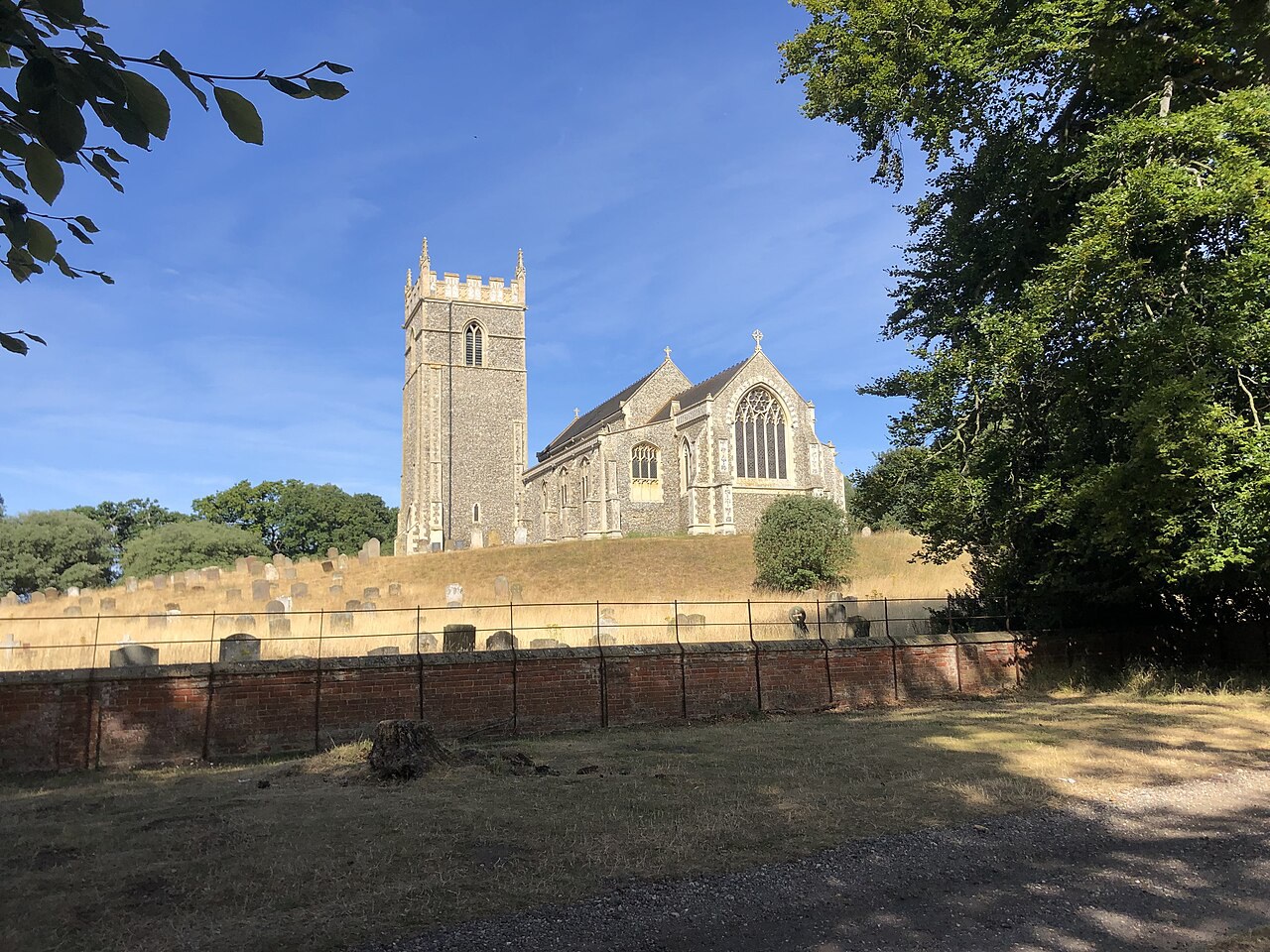
The parish church, St Withburga's, stands on a large mound west of the hall, inside the park. The mound may be man-made and pre-Anglo-Saxon; the southern base of the tower is 13th century, and the rest was largely rebuilt in 1767 and heavily restored between 1868 and 1871. That restoration was funded by Juliana Whitbread, Countess of Leicester, wife of the 2nd Earl, at a cost of around £9,000, and she is commemorated inside by a tomb chest designed by Sir Joseph Edgar Boehm. The Coke Mausoleum of 1870 stands in the churchyard, alongside the graves of many of the family. There's a tablet to nineteen village men lost in the First World War and two in the Second. The dedication to St Withburga — a 7th-century princess, daughter of King Anna of the East Angles, said to have been raised at Holkham — is believed to be unique; the village was once called Wihtburgstowe.
Domesday found Holkham a modest place. In 1086 there were twelve freemen and twelve smallholders, half a lord's plough team and three acres of meadow, and the whole thing was valued at £2 7s — exactly what it had been worth in 1066. The tenant-in-chief was Count Alan of Brittany, and the lord was a man named Tovi. The name Holkham may mean "homestead in a hollow," or it may come from hoelig, meaning holy, for St Withburga; either way the -ham is Old English for home.
Arrival and the winter landscape
Getting here takes some doing, which is part of why the beach stays empty. There is no station — the branch line and Holkham's own station opened in 1864 and closed in 1952 — so the nearest railheads are Sheringham and Cromer on the Bittern Line, or King's Lynn, twenty to twenty-five miles off. The village sits on the A149 coast road, about two miles west of Wells; the Coasthopper CH1 bus runs the coast road between Wells, Blakeney, Cley, Sheringham and Cromer, and the number 36 serves the village itself. If you'd rather arrive by steam, the Wells & Walsingham Light Railway runs nearby.
Anne Tennant, Baroness Glenconner, was born at the hall in 1932. So, in a manner of speaking, were the deer, the sheep-shearing shows and the reclaimed marsh. On a winter afternoon, with the geese coming in over the freshmarsh and the pines going dark behind the dunes, the whole enormous sweep of sand often has nobody on it at all — which the estate, having spent two centuries arranging everything else, cannot really take credit for.
Stay around Norfolk
Make a longer stay of it
Travel Fox holiday homes around Norfolk, linked directly to their property pages.
A guide with a point of view
Written from research. Edited for real journeys.
Use the Official site links for live practical details, then use this guide for context, ideas and room to explore.
Photography credits & licences
Third-party photographs are credited to their named creators and reused under the linked Creative Commons licence or public-domain dedication. Travel Fox stores an optimised local copy; the file-specific changes and any browser-applied display crop are disclosed below. Reused photographs link both to the Wikimedia Commons source record and to the declared source image; Travel Fox's own photographs carry no such record and are marked as ours. These image licences do not cover Travel Fox text, branding or page design.
- File:St Withburga's Church, Holkham - geograph.org.uk - 7485714.jpg — photograph by Eirian Evans; St Withburga's Church, Holkham by Eirian Evans. Source record on Wikimedia Commons. Declared source image. Licence: CC BY-SA 2.0. File changes: Downloaded from Wikimedia Commons, resized to a maximum 1920px edge and encoded as an optimised JPEG. Display changes: Displayed with responsive CSS cropping.
Sources
Every place on this page is checked against a published source. Each entry links the record we used and names who publishes it.
- The Victoria Inn — holkham.co.uk other published source
- Holkham Courtyard — holkham.co.uk operator, sector body or destination organisation
- The Lookout — holkham.co.uk other published source
- Holkham Walled Garden — holkham.co.uk operator, sector body or destination organisation
- Holkham Beach and National Nature Reserve — holkham.co.uk operator, sector body or destination organisation
- Holkham Park — holkham.co.uk operator, sector body or destination organisation
- The Coke Monument — holkham.co.uk other published source
- Holkham Hall — holkham.co.uk operator, sector body or destination organisation
- St Withburga's Church — historicengland.org.uk statutory register or public authority record not machine-readable; publisher restricts automated access